Previous Story
What is chimney flue guy wire anchoring and how is it done?
Posted On 24 May 2026
Comment: 0
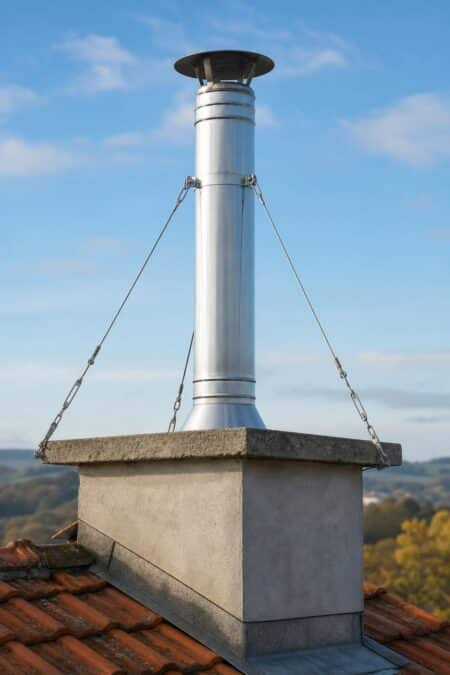
Guying consists of a set of ropes, known as guy wires, secured to fixed points and used to brace, stabilize, and ultimately immobilize a structural component. This procedure is required whenever the distance between the final support and the upper part of the conduit exceeds 1.5 meters, in accordance with Unified Technical Document 24.1.
lign: justify;”>
The five steps to guy-wiring your chimney
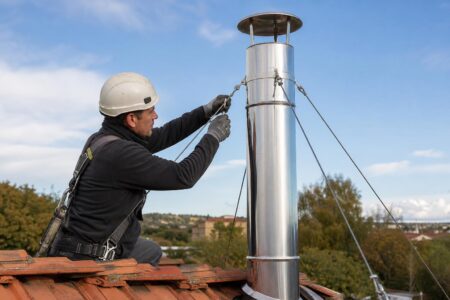
When a chimney extends 1.5 meters or more above the roofline, roof guy wire support is required. Without such a device, the structure could collapse during severe weather, leading to both property damage and personal injury. The steps for installing guy wires must be taken seriously; therefore, it is highly recommended that the installation be performed by a professional.
lign: justify;”>On this point, the’Andréas Company has skilled technicians for the’guying of your chimney. It provides high-quality services tailored to your specific needs. For more information regarding its activities, click this link.
Guy wires are tension cables that can be made of steel, stainless steel, wire, or even fiberglass. The choice depends on the buyer’s preference as well as the required strength of the guy wire. Before proceeding with the guy wire installation on the chimney, it is necessary to know the chimney’s outer diameter to properly mark the hole for the roof guy wire band. It is also necessary to measure the required lengths of the guy wires (the anchoring system component).
lign: justify;”>Installing the band on the chimney is performed by inserting a support bolt into a properly sized hole. The band is then wrapped around the chimney by securing each hole, including the center hole, onto its corresponding bolt.
The stay legs will then be secured to the stay band supports using slotted-head screws, lock washers, and hex nuts. The stay legs are assembled by sliding the provided clamp over the larger diameter leg and inserting the smaller diameter leg underneath it.
The roof guy-wire legs will then be released and extended until they make contact with the roof surface. It should be noted that the guy-wire must be securely fastened to a stable surface and positioned to account for wind oscillations to prevent breakage. The structure must be firmly anchored to the surface, whether on the roof or on the ground, by securing the end of the guy-wire with bolts or nails.
The final step involves verifying whether the material detaches easily from the cable clamp. If this occurs, the tightening procedure is inadequate. Consequently, each fastener must be retightened, starting with the clamps on the legs, followed by the strap and the supports already in place, and finally, the legs onto the strap. Ideally, the final tightening should be performed under maximum workload.
Everything you need to know about chimney flue guy-wiring
Successfully shoring up a chimney flue requires absolute technical rigour to guarantee the stability of your structure. Mastering measurements, choosing resistant materials such as steel or stainless steel, and the precise installation of bands and anchors are the pillars of long-lasting safety. By scrupulously following the steps for tensioning and checking cable clamps, you prevent the risk of collapse caused by adverse weather. Particular attention paid to the final tightening ensures the durability of the entire assembly against wind oscillations.
Mastering the technique of guy-wire installation for your chimney flue is a crucial step in ensuring the longevity of your installation and the safety of your home. By adhering to the 1.5-metre distance standards and ensuring the strength of the anchoring, you protect your structure against the risks of collapse caused by bad weather. The success of this system relies on a rigorous selection of materials, whether steel or fibreglass, as well as the precise application of assembly steps, from the placement of support bolts to the meticulous tightening of clamps. Particular attention paid to the tension of the guy wires and the stability of the fixing points allows for the compensation of wind-induced oscillations and prevents any accidental failure of the system.
Beyond simple technical implementation, the periodic maintenance and verification of fastening integrity constitute a major challenge in preventing material damage. A poorly adjusted device or hardware with faulty tightening can quickly compromise the stability of the entire structure. Given the complexity of the measurements and the risks of falls or structural damage, seeking the expertise of a qualified professional remains the most prudent strategy to validate the compliance of your installation. Before undertaking such security works, it is therefore recommended to have your situation analysed by a competent technician to ensure that every component perfectly meets the resistance and safety requirements of your roof.