Previous Story
Automobile : le secteur veut sa part du gâteau de la voiture connectée
Constructeurs et équipementiers automobiles espèrent bien tirer de nouveaux revenus du développement de la voiture connectée mais ils vont devoir affronter d’autres entreprises, notamment du monde de l’informatique, aussi décidées à prendre leur part du gâteau.
Le salon automobile IAA de Francfort qui ouvre ses portes jeudi, d’abord aux professionnels, est l’occasion pour eux de rivaliser de nouveautés.
L’équipementier français Valeo propose ainsi un système qui permet d’ouvrir et de faire démarrer sa voiture avec un smartphone et qui remplace la clé de contact. Il pourrait faire son apparition sur le marché d’ici quelques années.
L’allemand Opel et l’américain Ford ont annoncé avoir amélioré leur offre « mains-libres » qui permet de parler à sa voiture. Par exemple, nul besoin de taper l’adresse vers laquelle on se dirige sur son GPS, il suffit de la dire.
C’est souvent en partenariat avec des entreprises informatiques que les constructeurs automobiles ont développé leurs plate-formes de contenus embarqués. Elles permettent, via un écran, de téléphoner, de s’orienter, d’écouter la radio en flux continu (streaming) et d’avoir accès à différents services pendant son trajet grâce à une carte SIM intégrée qui donne accès au réseau téléphonique 3G.

Leur objectif est de « tirer des revenus réguliers » de cette offre, explique Samuel Ropert, consultant pour l’institut spécialisé dans les télécoms Idate. Mais selon lui, il n’est pas certain que les clients qui payent déjà un abonnement pour leur smartphone soient prêts à débourser de l’argent en plus, d’autant que ces systèmes ne sont pas compatibles entre eux.
Pour remédier à ce problème, Daimler, General Motors, Honda, Hyundai, PSA Peugeot Citroën, Toyota et Volkswagen ont collaboré avec des fabricants de smartphone (HTC, LG Electronics, Nokia, Panasonic et Samsung) pour développer un standard commun, Mirrorlink, afin de relier son smartphone à la voiture.
L’équipementier allemand Bosch fait aussi le pari d’un système ouvert, où le véhicule est connecté au téléphone du conducteur, qui retrouve alors certaines applications de son téléphone sur le tableau de bord.
Qui va contrôler les données?
Les acteurs traditionnels du secteur auto ne sont toutefois pas les seuls à s’intéresser à ce marché naissant, qui pourrait représenter 135 millions de véhicules d’ici 2018, selon une étude du cabinet Forrester Research. Des géants de l’Internet comme Google, des équipementiers en télécoms comme Cisco, des groupes informatiques comme Apple et d’autres encore le convoitent également.
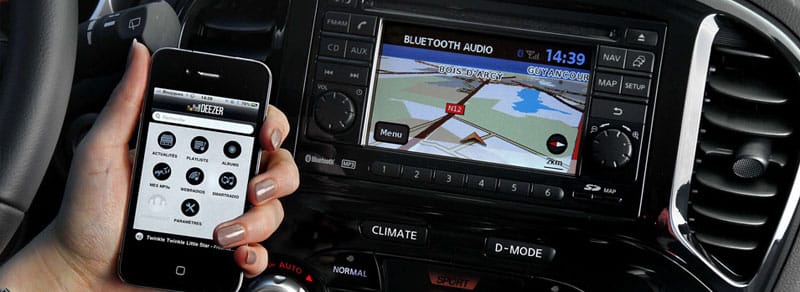
Apple vient de lancer son dernier système d’exploitation, iOS7, qui permet de connecter un iPhone 5 au système de navigation d’un véhicule et de pouvoir ainsi écouter de la musique, téléphoner ou encore accéder aux différentes applications sans lâcher son volant.
« Il s’agit d’une course de vitesse », qui va encore s’accélérer avec l’arrivée de la norme 4G, estime Patrick Pélata, en charge du programme de la voiture connectée chez le fabricant californien de logiciels Salesforce.
L’issue de la bataille est encore ouverte, explique l’ex-numéro deux de Renault, mais « d’ici deux ou trois ans, les jeux seront faits », l’enjeu étant de savoir qui va contrôler les données concernant le client, qui vont permettre de facturer de nouveaux services.
Selon Christoph Stürmer, expert automobile du cabinet de conseil IHS, « la question est de savoir qui va gagner de l’argent avec », alors que la forme que va prendre ce nouveau business model est encore floue.
Ces données peuvent permettre à un groupe automobile de mieux savoir quel usage est fait de la voiture et de proposer par exemple des services de maintenance adaptés, mais aussi un contrat d’assurance, de la musique, des adresses de restaurants ou d’hôtel et tout un tas d’autres services à la carte.
Pour les constructeurs et les équipementiers, le plus important sera « de bien se positionner dans les domaines où ils sont les plus compétents », comme la sécurité du véhicule, la gestion de flotte et les services à la mobilité, s’ils ne veulent pas rater le coche, avertit Rémy Cornubert, associé chez Oliver Wyman.