Previous Story

How to build a pétanque court
Posted On 25 May 2021
Comment: 0
*If you are considering building your own pétanque court, you will need to ask yourself several questions: “Do I really need to do this?”, “Will I see a return on my investment?”, or “What dimensions should it be?”. Continue reading our article to find all the answers to your questions and ensure you have everything you need to create the pétanque court of your dreams.*
How should the field be sized?
When planning to build your own pétanque court, the first question is usually regarding its dimensions. The answer is that there are no strict specifications for an exact size. However, the International Federation of Pétanque specifies that the standard size for a court is 4m x 15m (13′ x 50′), though this may vary. To be able to toss the jack at the maximum legal distance (10m), you will need a length of at least 12 meters.
What are the steps to constructing a pétanque court?
To build a pétanque court, start by spreading a layer of gravel across the area to assist with drainage. If the ground is prone to waterlogging, drainage channels must be installed first. This ensures it is much easier to construct your court on dry ground. Next, evenly spread a mixture of fine stones over the gravel until the gravel sits approximately 2 cm below the top layer. Variations in the playing surface are normal; the balls can be played on almost any soft, flat surface. The surface should be kept sufficiently dense and granular by raking it regularly. If it becomes too flat and compacted, the balls will roll too far and too fast. The goal is to achieve a solid surface that does not crumble, yet remains rough enough to slow the ball down.
How much does it cost to build a pétanque court?
The cost of a pétanque court depends on whether you undertake the construction yourself or outsource it. If you hire a landscaper to build your court, it could cost anywhere from 2,000 to 4,000 euros, depending on the materials used for the infill and the court’s perimeter. You must also account for the labor involved in transporting and disposing of excavated soil; while you can handle this yourself, if you lack the time or inclination, this must be factored into your budget. If we may offer one piece of advice, constructing a pétanque court is quite simple and accessible, even for those with limited DIY experience. There is no strictly necessary need to call in professionals, as the finishing of a pétanque court develops over time—and it certainly shouldn’t be perfectly smooth or flat; quite the opposite!
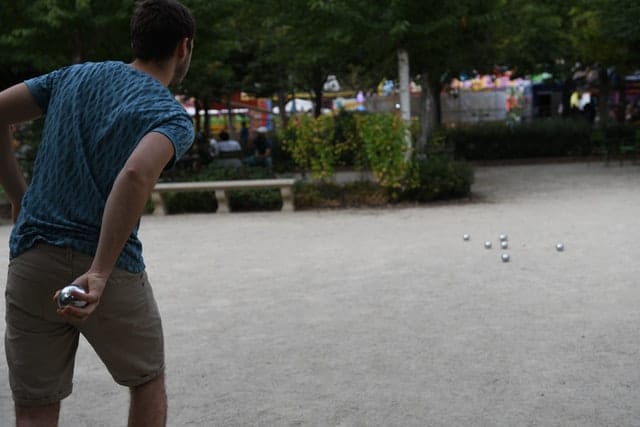 *To share your passion for pétanque beyond your own garden, you can follow the news of a professional club and even volunteer if time permits. This will allow you to follow competitions and player progress with an expert eye. If you are in the Lyon area, you might be interested in Lyon Canuts: a pétanque club led by* Patrick DUVARRY. This historic club, built on strong values, will undoubtedly provide you with expertise, enjoyment, and a sense of community. Visit their website for more information.